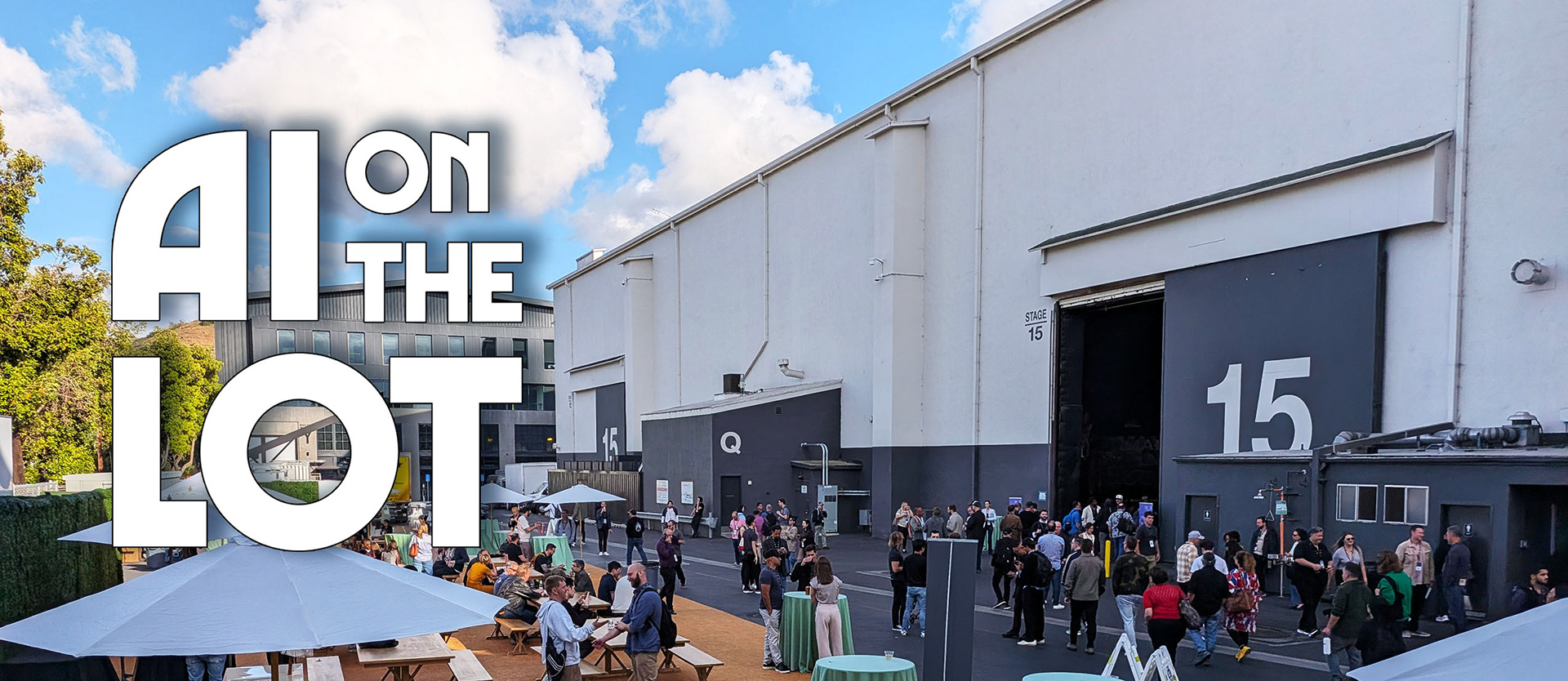
AI on the Lot 2026: A Briefing for Canadian Producers
by Sean Ward
by Sean Ward
The 2026 AI on the Lot conference at Amazon MGM Studios confirmed what many producers are still trying not to say out loud:
The AI tech demo era is over. The operational era has begun.
For the last two years, much of the conversation around generative AI in film has been trapped between spectacle and fear. On one side: surreal clips, prompt experiments, and impossible-looking shots. On the other: anxiety about labor, copyright, authorship, and whether the entire production model is about to collapse.
What became clear in Culver City is that the real frontier is no longer whether AI can generate impressive images.
The frontier is whether producers, agencies, studios, and creative teams can redesign their workflows fast enough to compete with the new economics.
I have already lived through one major media power shift: building a 4.7-million-subscriber YouTube franchise with more than 3 billion views while legacy entertainment was still treating online video as a sideshow. That experience made one thing at AI on the Lot impossible to ignore:
Film production is entering its own platform-shift moment.
The winners will not be the teams using AI as a slot machine. They will be the teams that understand how to combine traditional cinematic craft, human taste, compliance, production discipline, and frontier tools into repeatable pipelines.
Below are the four shifts I believe matter most.
Takeaway 1 // The Labour Realignment
The most obvious fear around AI is that it will eliminate crews. That is too simplistic.
The more accurate view is that AI changes which human decisions become valuable.
Prompting alone is not the moat. Taste is. Pipeline design is. Shot selection is. Production judgment is. Compliance is. The ability to know when to use AI, when not to use it, and how to document the human contribution is where the real value is moving.
Paul Schrader put the economic pressure bluntly during his keynote when he questioned the cost and logistics of traditional extras. Whether you agree with the framing or not, the underlying tension is real: the traditional model carries enormous overhead, and the new tools are forcing producers to rethink what needs to be physically produced, what can be augmented, and what should be generated.
But the companies that thrive will be the ones building hybrid workflows where every input is specific, intentional, and traceable.
The future is not “no crew.” The future is smaller, sharper, more technically fluent teams doing higher-leverage work.
Takeaway 2 // The Economic Inversion
For decades, capital and infrastructure protected high-end production companies from smaller competitors. That protection is eroding.
The most important shift is that the final 20% of cinematic polish (the expensive layer of post-production, VFX, lighting, environments, and iteration that used to separate indie work from studio work) is becoming a workflow problem.
At AI on the Lot, South Korea’s Meta-K showed how major commercial pipelines that once cost millions can now be restructured through hybrid AI workflows at a fraction of the cost. That does not mean craft disappears. It means the economics of craft change.
The strongest opportunity is what I would call Invisible AI: keeping the value of physical production — actors, sets, performances, cameras, crews — while using AI underneath the surface to expand what’s possible. Lighting changes. Dynamic environment plates. Complex stunts. VFX-heavy sequences. Iteration that would previously be too slow, too dangerous, or too expensive.
Generative tools can get a team to 80% quickly. Commercial-grade execution still requires human artistry, structure, and taste.
That is where the margin will be won.
Takeaway 3 // The Resistance
The resistance to AI is real, and much of it is understandable.
Public backlash, union concerns, copyright uncertainty, chain-of-title questions, cultural funding requirements, and reputational risk all matter. For Canadian producers especially, these are not abstract concerns. They affect financing, tax credits, public perception, and the viability of a production.
But fear cannot be the technical roadmap.
The builders are moving forward by reframing AI around risk mitigation, documentation, compliance, and workforce upskilling.
One of the most important examples discussed at the conference was Jon Erwin’s AI-integrated production model for House of David, which reportedly employed more than 600 people. That kind of example complicates the lazy narrative that AI integration automatically equals job elimination.
The stronger position is this:
AI should not be treated as a magic button. It should be treated as an engine inside a controlled production system.
When human interventions are documented, when creative choices are traceable, and when the workflow is intentionally designed, AI becomes easier to defend creatively, legally, and commercially.
For studios, agencies, and producers, this is the opportunity: turn AI from a perceived liability into a competitive advantage.
Not by hiding it.
By operationalizing it responsibly.
Takeaway 4 // The Do-Over
The subtext in the room was impossible to miss: Hollywood knows it missed the first wave of creator-led media. YouTube, TikTok, and social video rewired audience behavior while traditional entertainment spent years treating them as secondary channels.
Generative AI now feels like a second chance. But this time, the pressure is coming from both directions.
On one side, major studios and established producers are trying to understand how to integrate AI without breaking their labor models, legal structures, or brand trust.
On the other side, a decentralized frontier of small teams and independent creators now has access to tools that radically lower the barrier to high-end visual production.
Director Gareth Edwards compared traditional filmmaking to an orchestra playing from sheet music, and generative AI to the arrival of the electric guitar: suddenly, kids in bedrooms could make something loud, emotional, and culturally disruptive.
That may be the right analogy.
The next competitive threat to a traditional production company may not be another studio.
It’s more likely to be a five-person team with taste, speed, technical fluency, and no legacy infrastructure to protect.
Conclusion // Bridging the Frontier
The divide going forward will not be between people who use AI and people who do not. That gap is already closing. The real divide will be between reactive organizations and intentional ones.
Reactive teams will chase tools, panic over headlines, and bolt AI onto old workflows.
Intentional teams will redesign their pipelines around the new economics while preserving what still matters: story, performance, authorship, craft, taste, and trust.
That is the bridge this moment requires. Not blind adoption. Not fear-based rejection.
A disciplined, cinematic, human-led operating model for the AI era.
If you are trying to understand what this shift means for your slate, your agency, your production model, your margins, or your next pitch, I would be happy to compare notes. Whether you are curious, cautious, experimenting, or already deploying, reply with where you are in the AI conversation. I can share the most useful next step I am seeing from the field.
Sean Ward is a filmmaker and digital pioneer whose career has spanned TV, music, live events, and online video. He built a YouTube franchise to 4.7 million subscribers with 3 billion video views and a top-ten most-viewed video on the platform. As the founder of Poetic Menace Studio, he has fully embraced the AI era, solving high-stakes workflow challenges for enterprises and broadcasters while developing his own slate of AI-augmented features, including the upcoming sci-fi horror film, Galactic Riff.
Contact: